 Sushiswap
Sushiswap price impact and minimum swap output
Sushiswap price impact describes the change in execution price that your trade causes as it uses available liquidity. For an exact-input swap, the quoted output already reflects the route's expected execution. Minimum output sets the least amount that the transaction may deliver under its protection rule. A tight tolerance can still permit a poor quote when price impact is already high. Trade size and route liquidity determine that starting quote. Market changes before execution can reduce output further. Compare the quote with its minimum before confirming, then distinguish a rejected transaction from one that remains pending.
Trade size and active route liquidity
A swap's impact depends on its input amount relative to the liquidity that the selected route can use. Total value in a pool does not describe every executable price.
Reserve depth
V2 pools follow a constant-product relationship between token reserves, so adding the input token and withdrawing the output token changes their ratio and moves the average execution rate away from the pool's starting marginal price. Increasing input relative to reserves generally worsens the average rate when liquidity and other conditions remain unchanged. The pool's price after the trade and the trade's average execution price measure different points on this curve.
Active ranges and pool hops
V3 concentrates liquidity within price ranges, so a swap uses the liquidity active along its price path, which can change across range boundaries. A pool's displayed total can include liquidity outside the price intervals that the swap reaches. Routing through several liquidity pools adds dependencies on each leg's depth and fee, while a split route distributes volume across available sources. Neither route design can create liquidity. Compare quoted final output for the same input amount, since a route's complexity alone does not establish its quality.
What does slippage tolerance allow the swap to receive?
Slippage tolerance defines how far execution may deteriorate from the quote before the output protection rejects the swap. The tolerance applies to the quoted output, even when the quoted rate is already unfavorable.
Quoted output and its floor
Let Q represent quoted output and M the submitted minimum, both in the output token's units. The permitted fractional shortfall equals (Q - M) / Q. Conversely, an output-based tolerance t gives M = Q × (1 - t). A percentage tolerance p becomes t = p / 100.
The gap Q - M equals Q × t under that calculation. This allowance is room for output deterioration, not an automatic deduction. The actual encoded minimum controls execution. Token precision and any route-specific adjustments matter when converting the displayed quantity into the transaction's integer units.
Quote acceptance and trade cost
Price impact already influences Q, so subtracting that impact again would count the same effect twice. Changing tolerance alone leaves the underlying route quote unchanged when other inputs remain fixed. Changing the input amount or available route instead requires a new quote, whose minimum must relate to that new output.
An exact-output method fixes what the trade buys and bounds what it may spend. Its maximum-input calculation differs from this minimum-output calculation.
Quote drift before transaction inclusion
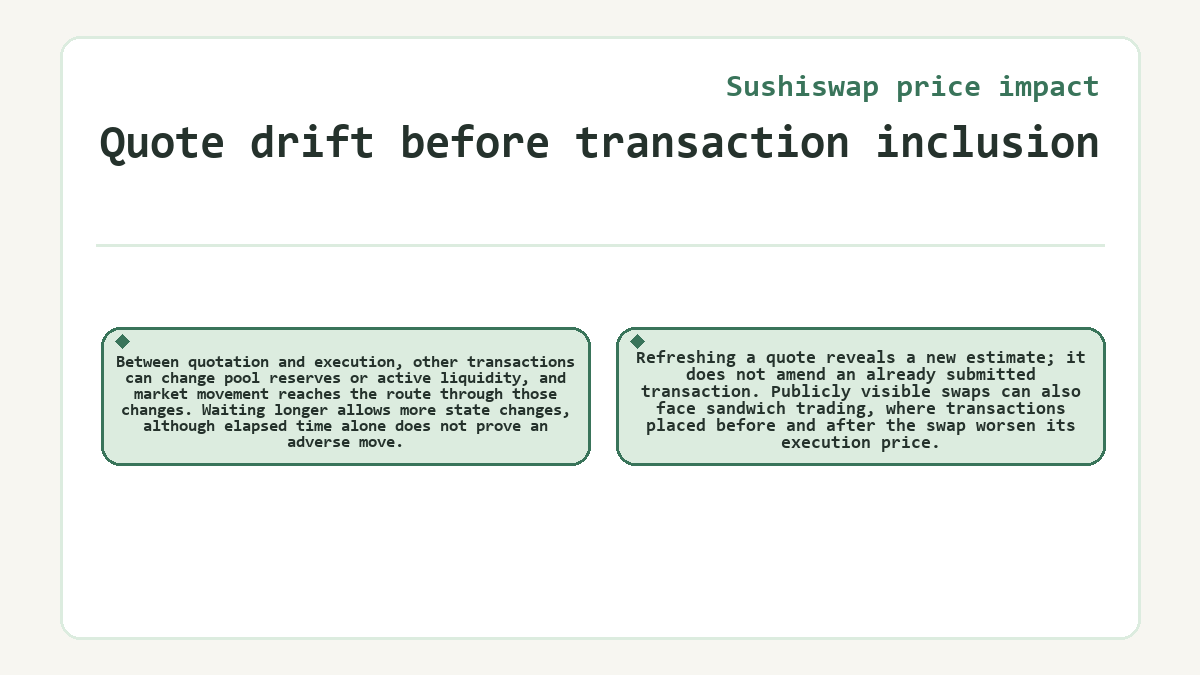
Between quotation and execution, other transactions can change pool reserves or active liquidity, and market movement reaches the route through those changes. Waiting longer allows more state changes, although elapsed time alone does not prove an adverse move. Refreshing a quote reveals a new estimate; it does not amend an already submitted transaction. Publicly visible swaps can also face sandwich trading, where transactions placed before and after the swap worsen its execution price.
When does a minimum-output check reject a swap?
The V2 router's standard exact-input methods reject a swap when calculated output falls below amountOutMin. For token-output swaps, its fee-on-transfer methods instead check the recipient's balance increase. The applicable method determines what the minimum protects. A simulation can expose a failing check before submission, although later state changes can invalidate a passing simulation.
Input balance, token spending permission and route compatibility are separate prerequisites. Raising tolerance does not repair them. A price-impact warning concerns the quoted rate; it does not identify a failed on-chain minimum check. A quote that finds no usable route has not reached execution. Distinguish that condition from a mined transaction whose receipt records failure.
Fees beside the token output
Pool and routing charges affect the swap's economics, while the network fee pays for transaction execution. Read the quoted token output alongside its fee breakdown, counting any included charge only once, because each pool can charge for the liquidity that its leg of the selected route uses. The minimum-output bound does not cap a separately paid network fee. Paying more for transaction inclusion does not increase pool depth or remove price impact already present in the quote.
Choices that change the quote or its protection
Reducing trade size changes the price path, while changing tolerance adjusts permission to accept quote drift. Routes and timing can change liquidity conditions. These choices affect different parts of execution, so compare the new quoted output and minimum whenever the input or route changes.
| Adjustment | Control and execution constraint |
|---|---|
| Smaller input amount | You choose the amount; available liquidity determines the new quote. |
| Different available route | The routing system finds compatible liquidity; execution depends on the selected pools. |
| Refreshed quote | A new estimate uses refreshed state; an existing signed transaction retains its bound. |
| Lower tolerance | You raise the floor for the same quote and accept more rejection risk. |
| Higher tolerance | You lower the floor for the same quote and allow worse execution. |
| Separate sequential swaps | Each swap has its own quote and bound; earlier fills can affect later quotes when swaps reuse a pool. |
| Deferred submission | You control submission timing; future liquidity and output remain unknown. |
| Overall effect | Amount and route change the quote; tolerance changes the acceptable output floor. |
Without intervening trades or liquidity changes, consecutive pieces through the same constant-product pool do not reset its pricing curve. Splitting therefore does not promise a better aggregate rate. Each on-chain swap can also incur a network charge. A wider tolerance leaves more room for adverse transaction ordering within the permitted output bound.
Receipt evidence before another attempt
A retry needs the prior transaction's status because a pending swap may still execute. Replacing a pending transaction solely to raise its gas fee can preserve the original swap parameters and minimum. Changing the input amount or route requires a fresh quote and minimum.
Pending or failed execution
A pending transaction establishes neither delivered output nor final failure. Its existing minimum still belongs to that transaction. A failed receipt establishes that this same-network atomic swap did not settle, while a separate approval transaction can remain effective. The revert reason or simulation helps identify whether output protection, token transfer behavior or another prerequisite caused failure. A retry needs parameters that address that cause; widening tolerance only changes its output floor.
Output recorded for the recipient
For token output, the receipt's transfer logs help identify the amount and recipient. Native currency output can require transaction traces to establish the payout. Balance snapshots from different times can include unrelated transfers or gas spending, so they require matching transaction context, while raw token amounts need decimal conversion before comparison with displayed quantities. With A representing actual output and I the input spent on the swap, the fractional quote shortfall equals (Q - A) / Q, while the recorded execution rate in output units per input unit equals A / I.
What readers ask about Sushiswap price impact
Can execution deliver more than the quoted output?
Favorable pool-state changes can produce more output than the original quote. A minimum-output condition imposes a lower bound, so it does not by itself require execution to stop at the estimated amount. The actual delivery still follows the selected route and any applicable charges. Compare the recipient's recorded token quantity with the quote in matching units.
Will a reverted swap still incur a network fee?
On networks that use the Ethereum Virtual Machine, a mined swap that reverts still incurs gas charges. Gas pays for the computation that the network performed even when the trade fails its output check. A failed simulation or a rejected wallet prompt does not establish a mined failure. The transaction receipt records execution status and gas usage.
Is a zero minimum output an effective protection setting?
A zero minimum provides no positive output floor against adverse execution. The contract can satisfy that particular check even when the delivered amount falls far below the quote. Other contract rules may still reject the transaction, but this setting removes the quoted-output protection. It also leaves more room for unfavorable execution when transaction ordering changes pool prices.
How do transfer-tax tokens change minimum-output checks?
Transfer taxes can reduce the token amount that reaches the recipient independently of market movement. For token output, the V2 router's fee-on-transfer methods check the recipient's balance increase after transfer taxes and revert if it is below amountOutMin. Tax-aware routing may account for those deductions in the quote, with support depending on the selected method. Read any displayed tax together with the quote and minimum, avoiding a second deduction when the estimate already includes it. Increasing tolerance cannot make an incompatible token transfer method compatible.
What does a successful Swap API response prove about a quote?
A Swap API response with status Success reports a usable route and prepared transaction data. Its output amount remains an estimate for that route. The response can arrive before wallet submission, so its status does not establish received tokens. A blockchain receipt and the recipient's recorded output establish whether the prepared swap executed and what it delivered.