 Sushiswap
Sushiswap liquidity pools let providers earn fees from swaps that use their liquidity
Sushiswap liquidity pools hold assets for automated swaps, with V2 and V3 allocating trading fees to liquidity providers, or LPs. V2 deposits create a share of full-range reserves, while V3 deposits create positions with chosen price boundaries. Earnings depend on trading through the relevant pool and, for V3, participation inside the selected range. Swaps also change the assets behind a position, so fee income and the value returned on withdrawal answer different questions.
Swap flow determines each position's fee income
V2 and V3 pool trading generates LP fee revenue, with the applicable pool design determining each provider's share. A V2 position earns through its proportion of the pool's liquidity. V3 allocates swap fees across the liquidity that participates along the swap's price path. That makes the amount of participating liquidity relevant alongside the volume that reaches the pool.
The standard V2 pair contract charges 0.3% of the input-token amount in a swap. Its protocol-fee configuration affects how much fee growth belongs to ordinary LP shares. A V3 pool has a defined fee tier and a configurable protocol share. The pool's settings determine the charge and allocation. Network transaction fees pay for execution; LPs do not receive them as pool trading fees.
Trading volume elsewhere on the platform adds no fees to a pool that the route bypasses. For an unchanged position, additional participating liquidity reduces its fee share when the same swaps reach the pool. Deeper active liquidity can reduce price impact, which influences whether routing selects that pool. Incentive rewards, when a pool offers them, have separate eligibility and distribution rules. A fee-based annual percentage rate, or APR, annualizes earnings from an observation window. It can change with traded volume, participating liquidity and time spent outside a position's range.
Price movement changes the assets behind the position
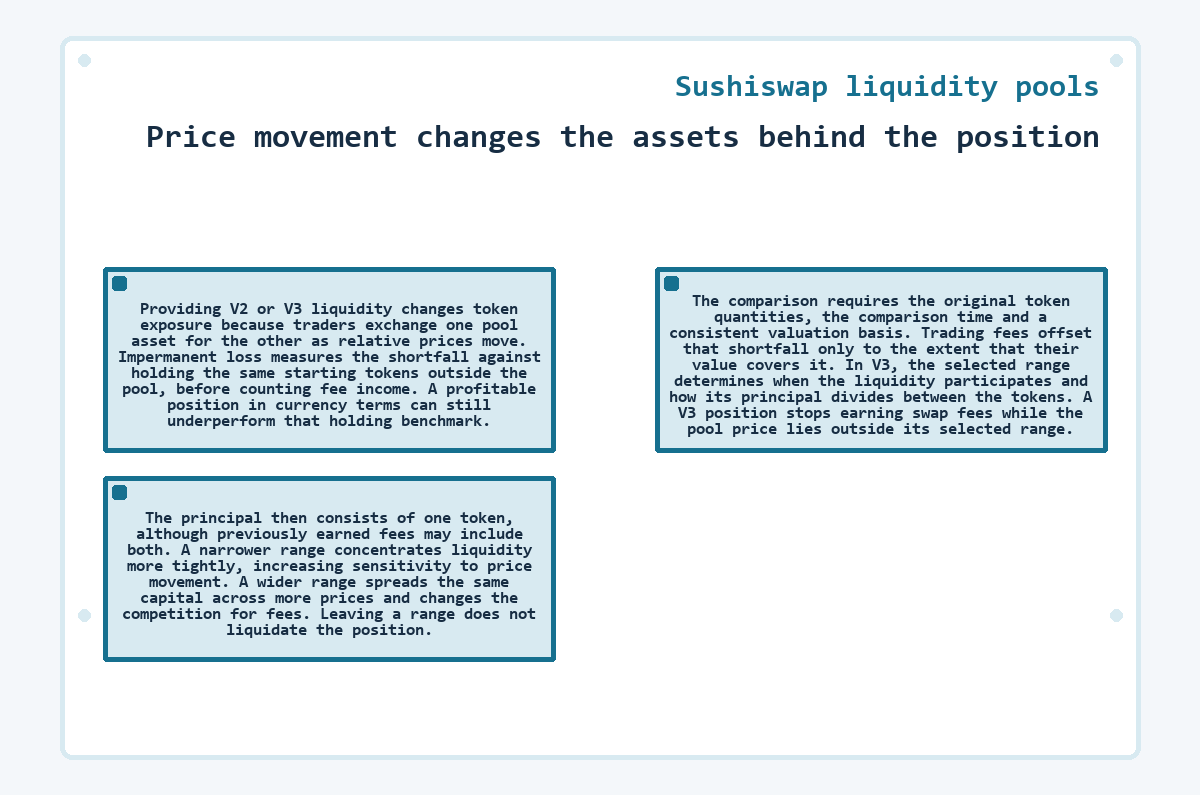
Providing V2 or V3 liquidity changes token exposure because traders exchange one pool asset for the other as relative prices move. Impermanent loss measures the shortfall against holding the same starting tokens outside the pool, before counting fee income. A profitable position in currency terms can still underperform that holding benchmark. The comparison requires the original token quantities, the comparison time and a consistent valuation basis. Trading fees offset that shortfall only to the extent that their value covers it.
In V3, the selected range determines when the liquidity participates and how its principal divides between the tokens. A V3 position stops earning swap fees while the pool price lies outside its selected range. The principal then consists of one token, although previously earned fees may include both. A narrower range concentrates liquidity more tightly, increasing sensitivity to price movement. A wider range spreads the same capital across more prices and changes the competition for fees. Leaving a range does not liquidate the position.
What determines the token amounts in an LP deposit?
Deposit amounts follow the pool's reserve ratio in V2 and the selected range relative to pool price in V3. An ordinary V2 deposit supplies both assets in proportion to existing reserves. Equal value at the pool's own price does not mean equal token quantities. V3 uses the price boundaries and current pool price to calculate the required mix. A range beyond the current price can require only one of the pair's tokens.
The network, token contracts and pool version identify where the deposit belongs. Matching tickers alone cannot establish token identity or contract compatibility.
Creating a new pool also requires a starting price that values the assets correctly relative to each other. An incorrect initial ratio can give arbitrage traders an opportunity to remove value through corrective swaps. Adding to an existing pool uses its established price and liquidity conditions. The V3 contract uses discrete price steps, called ticks, and each enabled fee tier has a tick spacing. Valid range boundaries must follow that spacing, so an arbitrary decimal boundary may need adjustment.
A token allowance permits contract spending; it does not create a pool share or a funded position.
A confirmed V3 position can exist before fees accrue
A successful V3 deposit can establish ownership before swaps generate any trading fees for the new position. How does confirming it compare with confirming a V2 pool share? In this hypothetical comparison, both pools use the same pair on the same network, with unchanged available balances. A V2 deposit credits LP tokens to the recipient. For a new V3 position, a non-fungible token (NFT) records ownership. V2 provides a reserve-based share without chosen price boundaries. V3 makes those boundaries explicit, with a deposit mix that depends on their relationship to pool price. Assume the reader selects V3 with sufficient balances, valid spending permission and a range containing the pool price.
After a successful liquidity transaction, the expected position names the intended token contracts, fee tier and range. It also assigns the position to the selected recipient and records positive liquidity. In this case, the observed contract record matches those fields before any swap uses the new position. No swap fees have accrued.
The reader can now monitor actual fee accrual without repeating the deposit. A pending deposit calls for waiting before resubmission. If only the approval succeeded, the liquidity deposit remains incomplete. A confirmed record with different token contracts or an unintended recipient calls for stopping further deposits and inspecting the discrepancy.
Smart Pools and Zap Mode change different parts of liquidity provision
Where available, Smart Pools automate range management, while Zap Mode changes how tokens for a supported deposit enter liquidity. Smart Pools powered by Steer Protocol apply strategies that manage concentrated liquidity and can reinvest collected fees. Their behavior depends on the vault's strategy and management rules, including any applicable charges. These strategies can still experience impermanent loss and periods without fee participation. Where Zap Mode is available, it swaps part of a single-token input into the pool's required mix before depositing. That entry route introduces swap execution costs and a slippage constraint. Availability depends on the selected network, pool and interface.
Blade used external market pricing in a managed vault design. Its pools are paused and withdrawal-only until further notice. Its yield model targeted portfolio-rebalancing gains, which differed from V2 and V3 swap-fee accounting.
Collecting fees and removing liquidity produce different balances
V2 withdrawals redeem LP shares against pool balances, so swap-fee growth returns with the underlying assets. The token quantities reflect the pool at redemption and can differ from the original deposit. A V2 LP token represents that claim on reserves, with accumulated fees embedded in their value.
The standard V3 position manager represents each position with an ERC-721 non-fungible token, or NFT. V3 positions allow fee collection without reducing the position's liquidity. Reducing V3 liquidity accounts for the released assets as tokens owed; collection transfers them to the chosen recipient. The position manager supports combining these operations in one transaction. Collected tokens can therefore include both trading fees and principal from a liquidity decrease. Collection and range adjustments incur network execution costs, which affect the net value of repeated management. Collecting fees preserves the price bounds of the V3 position.
Sushiswap liquidity pools: the short answers
Must a liquidity pair contain SUSHI to earn trading fees?
A liquidity pair does not need to contain SUSHI to earn fees from its own swaps. The pool's assets determine which tokens its fee accounting uses. Holding or staking a governance token is a different activity from providing the assets that a particular pool uses for trading.
Does transferring a V2 LP token transfer the associated withdrawal claim?
Transferring a V2 LP token transfers its associated share of the pool's redemption claim. The recipient controls that share, including its proportional exposure to the underlying reserves and embedded fees. Keeping the original deposit transaction does not preserve ownership of LP tokens that have left the wallet.
When can previously earned V3 fees be collected after a position leaves its range?
Previously accrued V3 fees remain collectible after the position leaves its range, provided they have not already been collected. Out-of-range status affects new swap-fee accrual. The position owner or an authorized operator can collect the amounts owed without waiting for the pool price to return inside the range.
Why can the same token pair appear in multiple V3 pools?
Different enabled fee tiers identify separate V3 pools for the same token pair within a factory. Each pool has its own liquidity, price state and fee accounting. A position in one tier receives no trading fees from swaps that use another tier's pool, even when the displayed token names match.
Where do unused tokens go after a direct V3 deposit?
Unused approved ERC-20 tokens remain in the wallet when a direct V3 position-manager deposit spends only the amounts needed for the position. Desired amounts constrain the allocation; the current pool price and selected range determine the actual token mix. The spending allowance remains separate from the amount that the position actually consumes.
Is removing part of a V3 position possible?
The V3 position manager supports decreasing part of a position's liquidity while retaining the remainder. The remaining liquidity keeps the same token pair, fee tier and range. The decrease accounts for the released tokens as amounts owed, which collection then transfers to the selected recipient.
Are liquidity positions and pool balances private?
Standard V2 reserves and V3 position records are public contract data. Their records expose token addresses and liquidity details, and position ownership identifies an address that may belong to a wallet or a contract. They do not require someone to know a private key to inspect those fields. A wallet address alone does not establish its owner's real-world identity.
What remains after all liquidity has been removed from a V3 position?
A V3 position NFT can remain after its liquidity reaches zero. Released principal or uncollected fees may still be owed to that position. Deleting the NFT requires zero remaining liquidity and clearing all amounts owed. Removing liquidity, collecting tokens and deleting the NFT are distinct operations, even when an interface bundles them.